


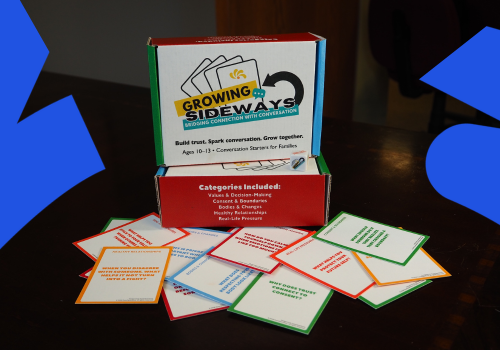
Meaningful conversations between young people and trusted adults matter, but that does not always make them easy to start. Conversations about puberty, relationships, boundaries, consent, emotional well-being, and growing up can often feel awkward, intimidating, or overwhelming for both youth and caregivers. At EyesOpenIowa, we believe those conversations should feel approachable, engaging, and rooted in trust rather than fear or discomfort.
That belief helped inspire Growing Sideways, our conversation-based card game designed to support communication, connection, and relationship-building between youth and trusted adults. But before expanding and redesigning the game, we wanted to pause and ask an important question: What would actually help families feel more comfortable having these conversations together?
A Project Rooted in Conversation
Growing Sideways did not appear overnight. The project builds on years of family engagement, sexual health education, prevention work, and community conversations facilitated through EyesOpenIowa. Earlier versions of the project began as conversation and trivia-style tools designed to help make difficult topics feel less intimidating and more approachable.
As the project evolved, so did our understanding of what families and young people needed. We recognized that communication barriers were often not caused by a lack of care or interest, but by discomfort, uncertainty, generational communication gaps, and the absence of engaging tools that felt natural to use together.
That realization pushed us to revisit, redesign, and eventually rebrand the project into what now known as Growing Sideways: a youth-centered conversation card game focused on helping trusted adults and youth build communication skills, empathy, trust, and confidence through interactive gameplay.
The goal was never to create another lecture-style educational tool. We wanted to create something families would actually want to pull out at the table, during game night, or while spending time together.
Why We Turned to Parent Feedback
Before moving forward with major revisions to the game, we knew we needed to hear directly from the people we hoped would eventually use it. During our time with Launch, we conducted a community survey through multiple outreach pipelines, organizational networks, and community spaces. Participants were asked what they would want in a conversation-based game or card deck designed to support communication with young people. Families participating in prototype testing received game materials and were invited to complete multiple rounds of feedback surveys following gameplay, with compensation provided to support continued participation throughout the testing process.
This process was incredibly important to us because community-informed development has always been central to how we approach our work. We wanted the game to feel practical, approachable, relevant, and realistic for actual families navigating real conversations.
The feedback we received helped validate some assumptions, challenged others, and ultimately shaped the direction of the updated Growing Sideways experience.
What Parents Told Us
Families wanted support for early adolescence.
One of the clearest findings from the survey was the age range during which parents felt they needed the most support.
- 55% of participants wanted the game to focus on youth ages 10–13
- 35% preferred content for ages 14–18
- 10% wanted content geared toward children under 10
This feedback strongly reinforced the importance of focusing on early adolescence, a developmental stage where young people are beginning to form beliefs about relationships, boundaries, self-worth, communication, and decision-making, while often remaining more open to conversations with trusted adults than older adolescents.
The results also helped shape how we approached tone, language, gameplay mechanics, and conversation depth within the game. We intentionally focused on creating prompts and scenarios that feel approachable, developmentally appropriate, relatable, and engaging rather than overly clinical or lecture-based.
Parents wanted conversations that felt relevant to real life.
Survey feedback also helped reshape the game’s categories and conversation structure.
Parents consistently highlighted the importance of conversations connected to real-life situations, communication challenges, emotional experiences, peer pressure, boundaries, relationships, and decision-making. Rather than organizing the game around more traditional educational categories alone, we shifted toward categories and prompts that better reflected the types of conversations families are already trying to navigate in everyday life.
This feedback helped influence the development of updated gameplay categories such as:
- Bodies & Changes
- Consent & Boundaries
- Healthy Relationships
- Values & Decision-Making
- Real-Life Pressures
- Shifts & Turns
We also expanded the game beyond traditional question-and-answer prompts to include role-play scenarios, “act it out” cards, humor-based prompts, reflection questions, and interactive group activities designed to make conversations feel more engaging and less intimidating.
Families wanted flexibility.
When asked about game format preferences, responses were nearly evenly split:
- 52.5% preferred a physical card deck
- 47.5% preferred digital access
These results highlighted something important: families want flexibility.
Some families value the hands-on experience and connection that comes from gathering around a physical game together. Others prioritize accessibility, convenience, portability, or digital options that fit more easily into busy schedules.
While Growing Sideways currently exists as a physical card game, this feedback reinforced the importance of continuing to think creatively about accessibility and how families engage with educational resources in different ways.
Affordability matters.
Pricing feedback also played an important role in our decision-making during the development process.
- 42.5% of respondents shared they would likely pay between $15–20
- 32.5% preferred a price point between $20–25
This feedback reinforced the importance of balancing affordability, accessibility, sustainability, and production realities as we continue refining the project.
As a small nonprofit organization, we want Growing Sideways to remain accessible to families while also building a sustainable model that allows the game to continue evolving, improving, and reaching more communities over time.
What We Learned
One of the biggest lessons from this process was the importance of listening before building.
The survey results validated many things we had already observed through years of community work and user testing, but they also challenged us to rethink aspects of the game’s tone, structure, accessibility, and gameplay experience.
Most importantly, the process reinforced that families do want to have these conversations. Many caregivers are actively looking for approachable, engaging, and emotionally safe ways to connect with young people around topics that can otherwise feel uncomfortable or difficult.
Community feedback did not just improve the project. It helped shape the heart of it.
Looking Ahead
Growing Sideways continues to evolve through community feedback, user testing, and ongoing collaboration with youth, caregivers, educators, and partners.
As we continue refining the game, we remain committed to creating resources that are approachable, affirming, accessible, and grounded in the real experiences of families and young people.
We are incredibly grateful to everyone who shared feedback, tested prototypes, asked questions, and helped shape this project along the way.
To follow the project’s progress, visit our website or stay connected with EyesOpenIowa on Facebook, Instagram, or LinkedIn.